
Power Electronics brings its grid connection experience to Auckland
On Tuesday 14 July, Power Electronics hosted a technical seminar in central Auckland, bringing Raul and Ander from the company’s Spain team to talk through the regulatory and technical shifts shaping how solar and battery storage projects connect to the New Zealand grid. The half-day session drew consultants, developers, EPCs and asset owners from across the renewables sector, all working through the same question: what does the next wave of grid connection require, and how do you deliver against it?
For those who could not make it, here is a recap of what we covered and why it matters for the projects taking shape across the country.
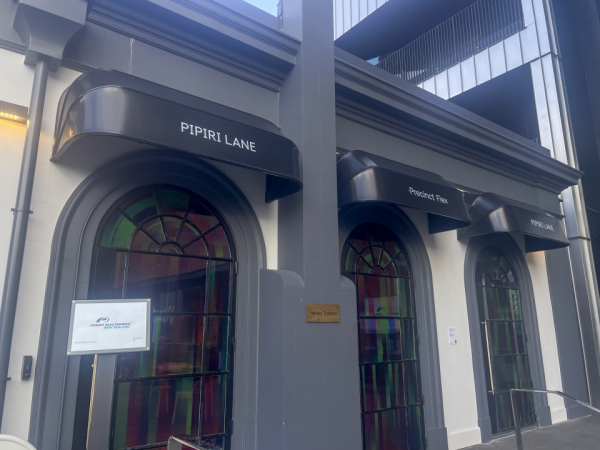
Power Electronics Auckland Technical Seminar was at Pipiri Lane by the waterfront.
A global partner with hands-on grid experience
Power Electronics has spent 38 years manufacturing solar and energy storage inverters, with more than 170 GW installed worldwide across 36 countries and over 3,500 solar and storage projects delivered. Annual production capacity now sits at 45 GW. The company works across five divisions: Solar, Storage, Data Centres, Mobility and Drives.
The message we opened with was a simple one. New Zealand is not the first market to work through the grid connection challenges it now faces. Australia, the United States and Europe have already moved through comparable transitions, and Power Electronics has operated inside every one of them. That experience, rather than a product catalogue, is what the team came to share.
Grid-forming and the case for VISMA
As more of the grid is served by inverter-based generation, system stability becomes harder to hold. Traditional grid-following inverters lean on the strength of the wider network. Push their penetration high enough and stability degrades. Grid-forming inverters change that equation by behaving as a voltage source.
This is where VISMA, Power Electronics’ Virtual Synchronous Machine technology, comes in. By emulating the behaviour of a rotating synchronous machine, VISMA improves the two measures system operators watch most closely during a disturbance: the rate of change of frequency and the frequency nadir, or how far frequency dips before it recovers. In practical terms, it lets a network absorb a much higher share of renewable generation while staying stable, which is exactly the direction New Zealand is heading.
CACTIS and getting projects connected
A large part of the seminar focused on the connection process itself, and the modelling now expected of new projects. Grid connection increasingly turns on how a plant is represented and validated in software before it ever reaches site, across tools including DIgSILENT PowerFactory, PSCAD, TSAT and WECC generic models.
Power Electronics validates its models against real field test results and against hardware, then makes them available in the encrypted and unencrypted forms system operators require. For developers and consultants navigating CACTIS and the wider shift in how solar and BESS projects are evaluated, having a manufacturer that arrives with validated, compliance-ready models is the difference between a connection that moves and one that stalls.
New Zealand’s grid connection landscape is changing, and CACTIS will reshape how solar and BESS projects are evaluated and connected. The value of experience is that you have seen where the process gets stuck before you get there.
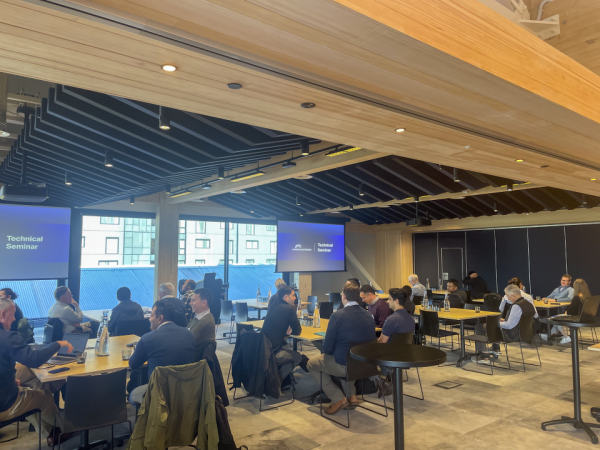
Before the seminar started. Live audience of the half day seminar.
GEN 3 2.0 and hybrid plants
On the equipment side, the team walked through GEN 3 2.0, the latest evolution of the GEN 3 platform. It keeps the same hardware design, firmware and power stage topology, but lifts power and reliability through new, more powerful semiconductors and a higher-rated medium voltage transformer, up from 4.2 MVA to 5.36 MVA. The result is better matching with higher-capacity storage and, importantly, greater overload capability for grid-forming operation.
We also covered hybrid plant configurations that combine solar and storage on a single connection. Alongside conventional AC coupling, the team explained reverse DC coupling, which connects the batteries directly to the storage inverter and the PV array through a DC/DC converter. For projects working to make the most of a constrained connection point, these architectures open real flexibility in plant design.
Powering data centres
One of the fastest-moving topics on the day was data centre power. AI workloads create abrupt, cyclical load changes, with power peaks that can exceed 100 kW per rack, and they are highly sensitive to voltage disturbances. That combination is pushing data centres toward battery-backed architectures that can shave peaks, ride through disturbances and, when needed, run as an autonomous microgrid in island mode.
The team traced the shift from today’s AC-based designs, which can lose around 10 percent of power across multiple conversion stages, toward a direct 800 V DC architecture that cuts those losses to roughly 1 percent while simplifying the system and enabling faster scaling. It is a clear signal of where high-density power is going.
Proven before it reaches the field
Underpinning all of it is testing. Power Electronics runs grid code compliance verification across 12 Hardware-in-the-Loop systems, connecting real inverter hardware to a simulated grid environment to replicate voltage dips, frequency deviations and transient faults before anything is deployed. That framework has carried the equipment through some of the most stringent grid codes in the world, including the Australian Grid Code and the requirements set by ERCOT, MISO, PJM, CAISO and IEEE 2800.
For a New Zealand audience, the point lands cleanly. The compliance work behind these products has already been done under codes as demanding as anything the local market is likely to introduce.
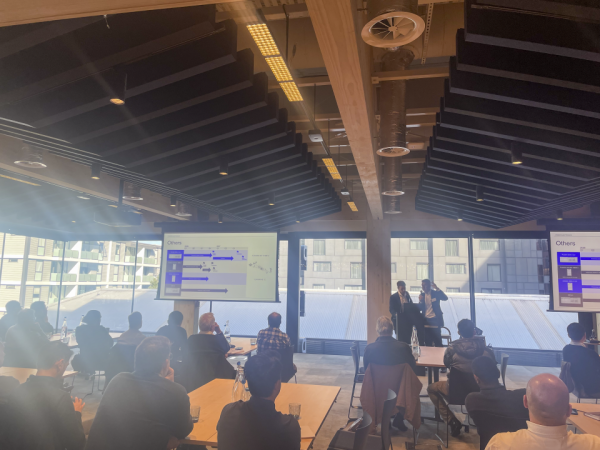
Raul & Ander speaking together.
What’s next
Thank you to everyone who joined us in Auckland, and to Raul and Ander for making the trip. It was a genuinely engaged room, and the conversations over lunch were as valuable as the session itself.
Power Electronics is here as a practical, experience-led partner for teams working through New Zealand’s new grid connection requirements. If you would like to talk through what any of this means for a project you are planning, or you would like the slides from the day, get in touch with the team.
Get the slides from the day
Want to go deeper? The full slide deck from the seminar, covering VISMA grid-forming, CACTIS and the connection process, GEN 3 2.0, hybrid plants and the data centre architectures, is available to download. Enter your details on the next page and we will send the slides straight through.
Access the slides
Takes less than a minute. We will only use your details to send the slides and relevant follow-up.